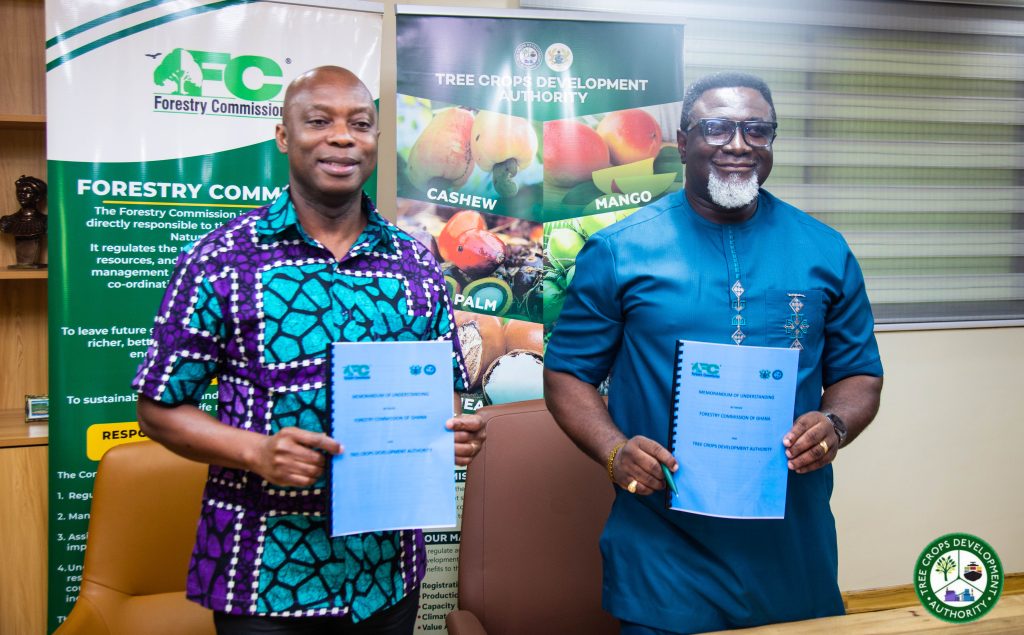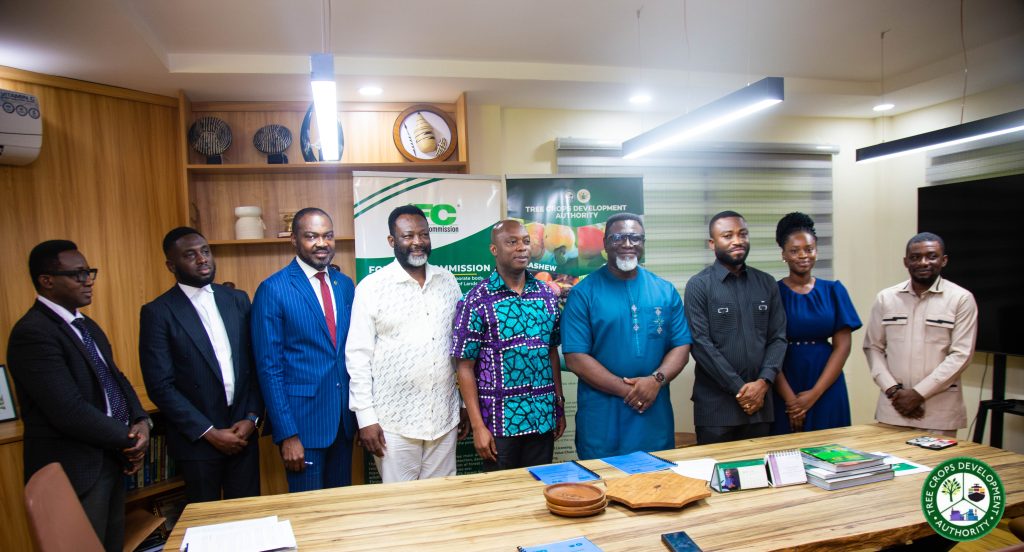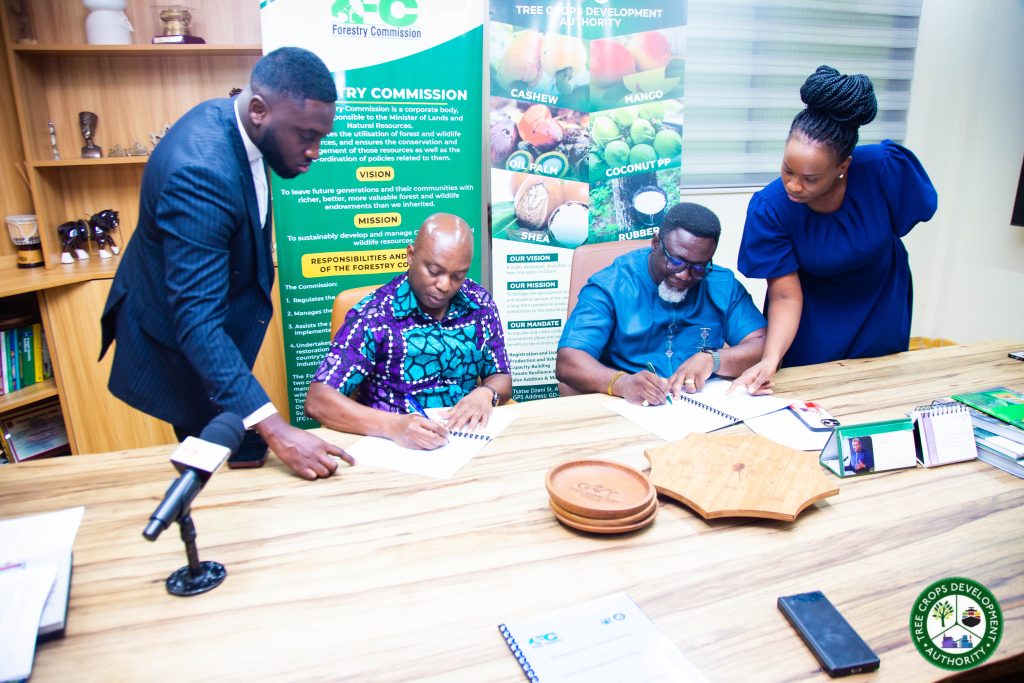
The Tree Crops Development Authority (TCDA) has signed a Memorandum of Understanding (MoU) with the Forestry Commission to leverage the Commission’s nationwide checkpoint infrastructure to enforce regulations governing the movement of tree crop commodities across Ghana.
The agreement is aimed at strengthening compliance and monitoring within the tree crops sector through the implementation of the Conveyance Certification System (CCS).Under the arrangement, Forestry Commission checkpoints across the country will be used to verify that all tree crop commodities in transit are accompanied by a valid TCDA Conveyance Certificate, as required under Legislative Instrument (L.I.) 2471.
Chief Executive Officer of TCDA, Andy Osei Okrah, described the partnership as a timely intervention to bring discipline, transparency, and accountability into the sector. He noted that the move forms part of broader efforts to sanitize the tree crops value chain and eliminate unregulated trade, particularly in key commodities such as cashew, rubber, and shea.
The Chief Executive of the Forestry Commission, Dr. Hugh Brown, also emphasized that the collaboration marks a shift from fragmented institutional operations to a more coordinated national approach to resource monitoring and regulation. The CCS, introduced by TCDA under Section 55 of L.I. 2471, is designed to track and regulate the transportation of six selected tree crops namely; cashew, coconut, oil palm, rubber, mango, and shea across the country. The system, now fully operational nationwide, requires all licensed traders, transporters, and other value chain actors to obtain a TCDA Conveyance Certificate prior to transporting these commodities. Certificates can be acquired at TCDA zonal offices or designated checkpoints at the source of the commodities.Failure to comply with the directive may attract sanctions under TCDA regulations and other applicable laws.
The implementation of the CCS is expected to curb theft and illegal trade, improve data collection, enhance regulatory compliance, and boost investor confidence in Ghana’s tree crops sector. The TCDA is therefore calling on all farmers, traders, transporters, exporters, and value chain actors to strictly comply with the new directive by obtaining the required Conveyance Certificate before transporting any tree crop commodities.
The Legal Foundation and Purpose of the CCS
As provided under Legislative Instrument (LI) 2471 (section 54 and 55), the CCS establishes clear and standardized guidelines for the transport, evacuation, and packaging of tree crop produce. These measures are designed to ensure that commodities move safely and efficiently from one location to another. By standardizing these processes, the CCS ensures that the actor who transports any of TCDA’s mandated tree crop commodities meets all requirements and the commodity is in condition approved by the Authority. This helps eliminate theft and illegal trading transactions from the system. Then also it enhances operational efficiency for traders and transporters, creating a more reliable and orderly system for all actors.
- Data as a Tool for Farmer Protection and Sector Growth
A key pillar of the CCS is its emphasis on data collection and traceability. The system captures critical information on produce volumes, movements, and transactions.
This is not a bureaucratic exercise, it is a strategic tool. Reliable data enables authorities to:
- Monitor market trends
- Identify challenges early
- Design targeted interventions
- Strengthen policy decisions
Most importantly, it ensures that transactions are transparent and accountable, reducing exploitation and strengthening market integrity. The Authority maintains that the partnership with the Forestry Commission represents a major step toward building a more transparent, well-regulated, and sustainable tree crops industry capable of driving economic growth and creating employment opportunities.